Most buyers do not think about resale when they purchase. They are focused on what the home offers them right now — the light, the layout, the neighborhood, the price. Resale is a distant abstraction.
The buyers who make the best real estate decisions think differently. They understand that the day they buy is the day they determine how easy or difficult their eventual sale will be. The choices made at purchase — about location, lot, floorplan, and property type — are far harder to change than paint colors or fixtures.
In Austin, where the market is hyper-local and buyer preferences are specific, resale value is shaped by a handful of factors that repeat consistently across transactions. Here is what they are.
Location Within the Micro-Market
Austin operates in micro-markets where location within a neighborhood matters as much as the neighborhood itself. A home on a quiet interior street in Barton Hills holds value differently than one on a through-street two blocks over. A home backing to Mopac or US-183 is priced at a discount and sells at one too — even if the interior is exceptional.
The features buyers respond to most consistently: proximity to green space or hike-and-bike trails, walkability to local amenities (coffee, groceries, restaurants), a quiet street that does not serve as a cut-through route, and lot context that is not adjacent to commercial, industrial, or high-density zoning.
School District Boundaries
No single factor shapes Austin home values more reliably than school district assignment. Austin ISD, Eanes ISD, and Lake Travis ISD are the three districts that most consistently command premium pricing. Within Austin ISD, the elementary school assignment matters further — homes zoned to Barton Hills, Casis, or Bryker Woods elementary schools trade at premiums over homes a few blocks away zoned elsewhere.
School zone boundaries in Austin are block-specific. Two homes on the same street can be assigned to different elementary schools. Before purchasing, verify the exact school zone for the specific address — not the general neighborhood. A home that falls outside a desirable boundary is harder to sell to the most price-insensitive buyer segment: families.
Lot Size and Usability
Austin's terrain is varied. A large lot sounds appealing until it has 40% slope and no flat usable area. A smaller lot that is fully flat, well-proportioned, and oriented well for natural light often sells more easily than a nominally larger one that is difficult to use.
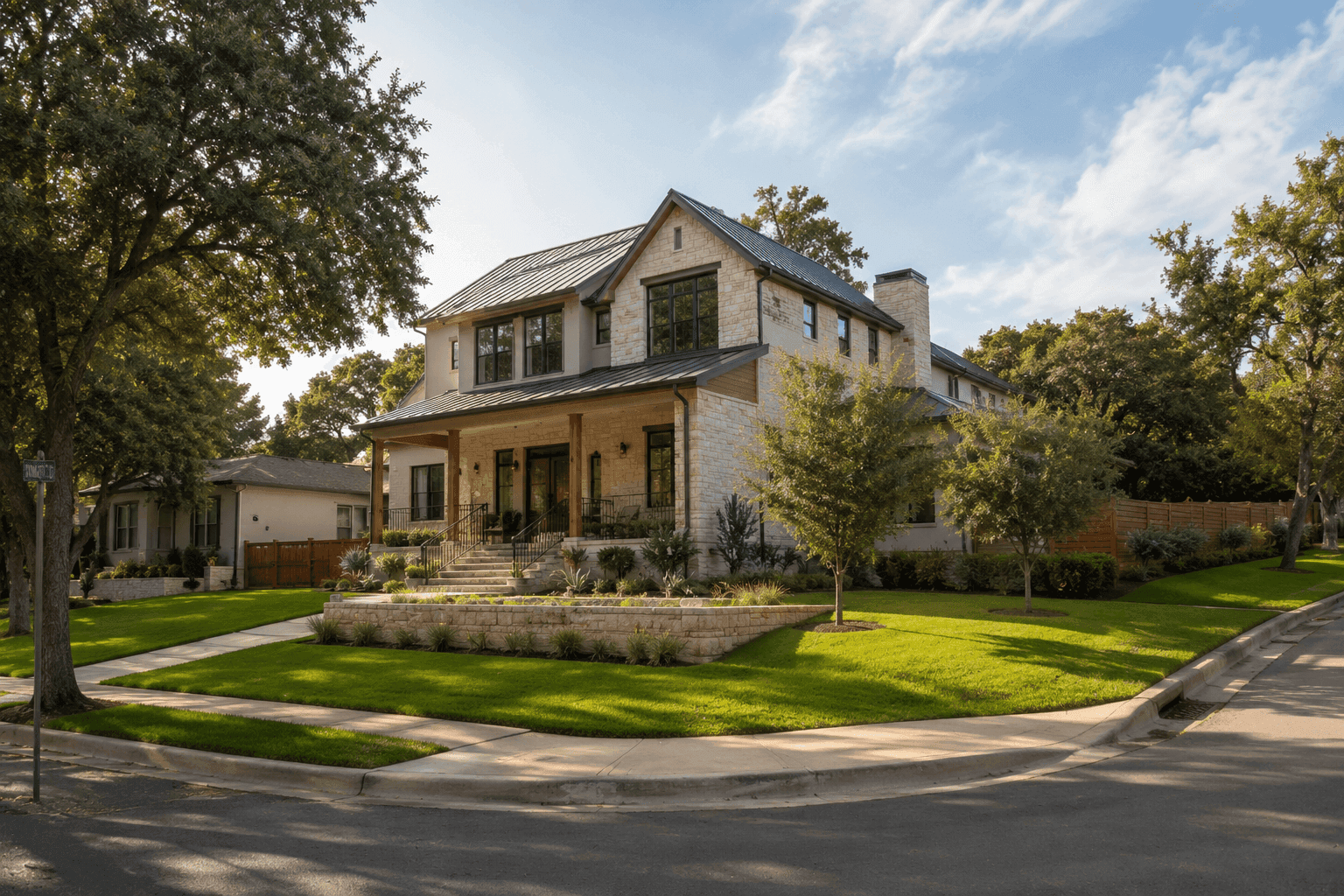
Corner lots present a specific tradeoff: more light and often more square footage, but less privacy and higher exposure to traffic. Buyers respond to corner lots unevenly — some pay a premium, others discount them. If resale is a priority, a well-sized interior lot with a flat grade and good orientation is the more reliably saleable asset.
Floorplan Fundamentals
Certain floorplan characteristics make Austin homes consistently easier to sell. Buyers — especially families and move-up buyers — want a primary suite on the main level or clearly separated from secondary bedrooms, at least three true bedrooms with closets, a functional kitchen that opens to the main living area, adequate storage (walk-in closets, a pantry, a garage), and at least a covered outdoor space.
The floorplan characteristics that consistently create friction at resale: a primary suite that is not meaningfully larger than the other bedrooms, bedrooms converted from dining rooms or bonus spaces, galley kitchens that are closed off from the living area, and homes with only one full bathroom regardless of bedroom count.
What to Look Past
Some features that feel like negatives at purchase have minimal resale impact because buyers understand they are changeable. Cosmetic conditions — dated fixtures, paint colors, flooring, landscaping — are priced into the market and bought by buyers who factor in renovation. A structurally sound, well-located home with a functional floorplan and a cosmetically dated interior is often a better resale asset than a renovated home with a fundamental layout or location issue.
The hierarchy is clear: location and lot cannot be changed. School zone assignment cannot be changed. Floorplan can be modified at significant cost. Everything cosmetic can be changed inexpensively. Buyers — and future buyers — know this. Price accordingly.
The Question to Ask Before Every Offer
Before submitting an offer on any Austin property, ask your advisor: what would make this home harder to sell in seven years? The answer is not a reason to walk away — it is information. A home that backs to a busy road can still be the right purchase if the price reflects it and your timeline accounts for it. A home in an inconvenient school zone might be perfect for a buyer without school-age children.
What matters is that the resale story is understood before you close, not discovered when you list. The buyers who make the best long-term decisions in Austin are the ones who ask this question before they fall in love — or right after, when the answer still has a chance of affecting what they decide.