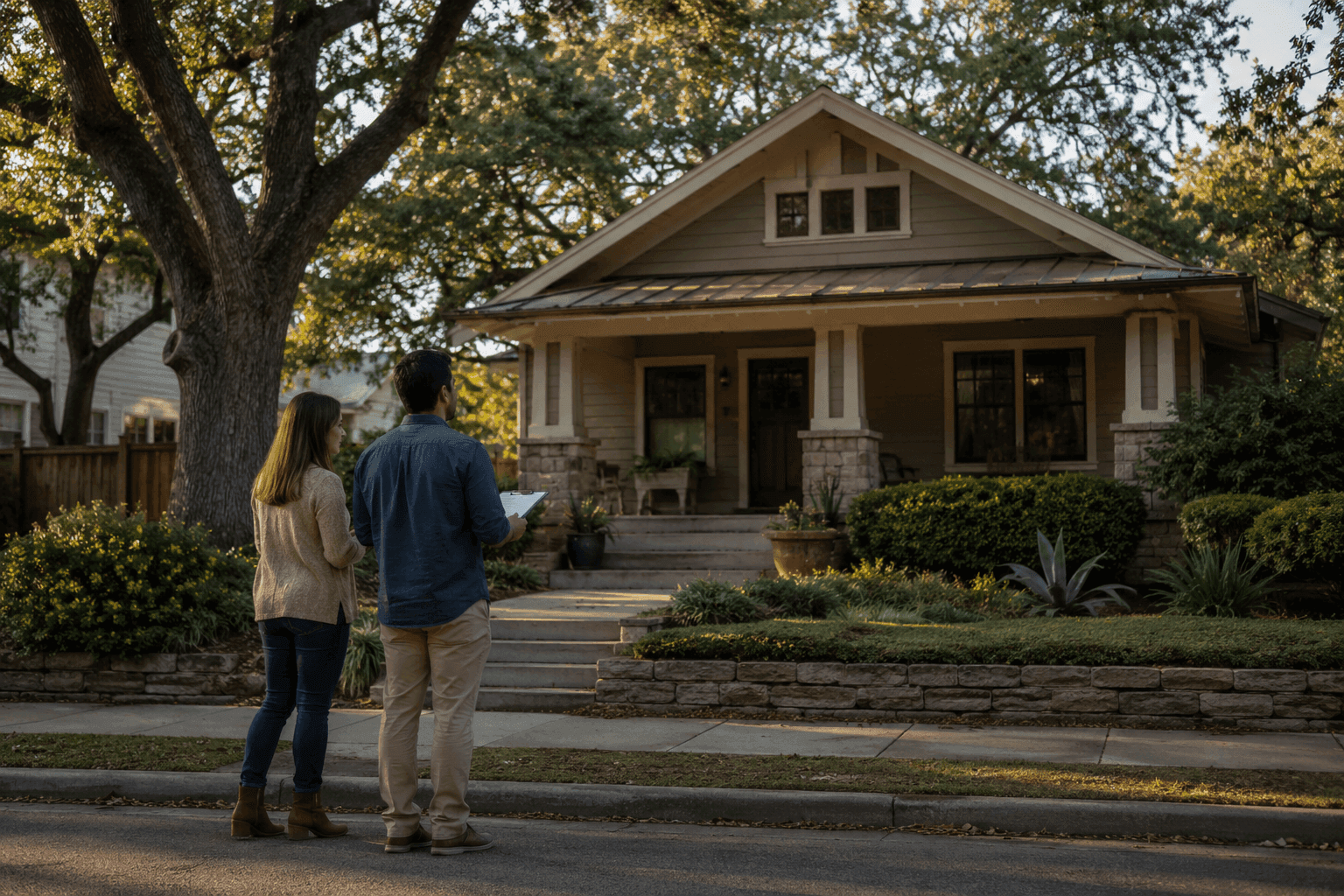
Buying your first home in Austin is one of the most meaningful financial decisions you will make — and one of the most complex processes most people have ever navigated.
The honest picture: Austin is expensive, competition for well-priced homes in desirable neighborhoods is real, and the process has more moving parts than most first-timers anticipate. But the market in 2026 is more accessible than it was at the 2022 peak. Inventory has improved, price growth has moderated, and down payment assistance programs have become more widely used.
This guide covers the full path — financing, down payment assistance, neighborhood strategy, offer dynamics, and what it actually takes to close your first Austin home.
Step One: Get Pre-Approved Before You Fall in Love with a Home
This is not optional advice. In Austin's active micro-markets, sellers and their agents filter buyers by pre-approval status before taking offers seriously. A buyer without pre-approval is not a credible buyer in Austin's competitive neighborhoods.
Pre-approval is different from pre-qualification. Pre-qualification is a surface estimate based on self-reported information. Pre-approval is a lender's verified assessment of your creditworthiness, income, and assets — the document that carries weight with sellers.
Get pre-approved before attending showings. Knowing your actual budget prevents you from falling in love with homes you cannot buy, and it means you can write an offer the same day you find the right home.
How Much Home Can You Afford in Austin?
At a 6.5% mortgage rate, a $450,000 loan requires roughly $2,850 in monthly principal and interest. Add Austin property taxes ($700 to $900 per month on a $500,000 home) and insurance ($150 to $250 per month), and total housing costs for a $500,000 purchase run approximately $3,700 to $4,000 per month.
At 28–30% of gross income, that payment level is sustainable for a household earning approximately $150,000 to $170,000 per year. Many Austin first-time buyers purchase with household incomes in the $90,000 to $130,000 range — which typically means looking in the $300,000 to $400,000 price range, or using down payment assistance programs to reduce the loan size.
Down Payment Assistance Programs Available in Texas
Texas offers meaningful down payment assistance for first-time buyers through two primary programs, both of which operate in Austin.
The Texas State Affordable Housing Corporation (TSAHC) offers the Homes for Texas Heroes program — for teachers, healthcare workers, police officers, firefighters, and veterans — and the Home Sweet Texas program for all first-time buyers. Both provide down payment assistance of up to 5% of the loan amount as a grant that does not need to be repaid, combined with a 30-year fixed-rate mortgage.
The Texas Department of Housing and Community Affairs (TDHCA) operates the My First Texas Home program, providing up to 5% in down payment assistance and below-market interest rate financing. Income and purchase price limits apply and vary by county — but in Travis County, the income limits are broader than many buyers expect. A household earning $90,000 to $110,000 may qualify depending on family size.
Choosing the Right Loan: FHA, Conventional, or VA
FHA loans require a minimum 3.5% down payment with a 580+ credit score. FHA loans are more accessible for buyers with moderate credit but carry mortgage insurance premiums for the life of the loan if the down payment is less than 10%.
Conventional loans are available to first-time buyers with as little as 3% down. With a 740+ credit score and 20% down, conventional loans offer the most favorable rates and eliminate private mortgage insurance. At less than 20% down, PMI applies until you reach 20% equity.
VA loans — available to veterans, active-duty service members, and qualifying surviving spouses — require no down payment and no mortgage insurance. Austin has a significant veteran and military population, and VA loans are common and powerful in this market.
Choosing the Right First Austin Neighborhood
First-time buyers in Austin face a common dilemma: the neighborhoods they are most drawn to are often the most expensive, and the most affordable options require trade-offs on commute, walkability, or school zone.
A realistic first-time buyer strategy in 2026 typically involves one of three approaches. The first: buying in an entry-level pocket of a desirable neighborhood — East Austin condos, Mueller townhomes, or South Austin bungalows that need updating. The second: moving to an outer-ring community (Cedar Park, Leander, Pflugerville, Kyle) where the same budget buys substantially more home. The third: house-hacking — purchasing a property with an ADU to generate rental income that offsets carrying costs.
Each approach has different lifestyle implications. An outer-ring purchase means a longer commute and a car-dependent lifestyle. An urban entry-level purchase means accepting a smaller home or more renovation. House-hacking requires landlord responsibilities.
The best first Austin purchase is one that is financially sound, in the right location for your life, and a property you can build equity in over time.
Writing a Competitive First Offer
First-time buyers often underestimate how competitive Austin's desirable price ranges are. Homes priced between $350,000 and $550,000 in established neighborhoods regularly attract multiple offers. Being pre-approved, flexible on closing timeline, and offering a competitive price based on actual comps matters in this segment.
Your agent will prepare a comparative market analysis before you write any offer. Understanding what comparable homes sold for — not just listed at — is the foundation of a competitive offer in Austin. Well-priced homes in active micro-markets do not wait.
Inspection, Appraisal, and Closing
Once an offer is accepted, you typically have 7 to 10 days for an inspection period. Hire a licensed inspector who will provide a detailed assessment of the home's condition — roof, foundation, mechanical systems, electrical, plumbing, and more. Inspection findings become negotiating points: buyers can request repairs, closing cost credits, or price reductions based on material findings.
Appraisal follows: your lender orders an independent assessment to confirm the home's value supports the purchase price. If the appraisal comes in lower than the purchase price, this triggers a renegotiation or requires the buyer to make up the gap in cash.
Closing typically occurs 30 to 45 days after an accepted offer. Closing costs — lender fees, title insurance, recording fees, prepaid taxes and insurance — typically run 2–3% of the purchase price. For a $450,000 purchase, plan for $9,000 to $13,500 in closing costs in addition to your down payment.
The Emotional Reality of Your First Austin Home
Buying a first home in Austin is emotionally demanding. The combination of large financial stakes, competitive market dynamics, and the genuine excitement of becoming a homeowner creates pressure that catches many first-timers off guard.
The buyers who navigate it best are those who have done their preparation before the emotion arrives — who know their budget, have their pre-approval in hand, and have done enough neighborhood research to make a confident decision when the right home appears.
A first home does not have to be perfect. It needs to be financially sound, in the right location, and a property you can build equity in over time.