A few years ago, adding an accessory dwelling unit to an Austin property required navigating a complicated set of restrictions — owner-occupancy requirements, limited lot eligibility, and setback rules that made many properties effectively ineligible.
That changed. Austin's HOME (Home Options for Middle-income Empowerment) initiative, adopted in phases between 2023 and 2024, removed the owner-occupancy requirement, expanded ADU eligibility to far more lots across the city, and reduced barriers that had kept the ADU market smaller than the demand for it.
In 2026, ADUs are one of the most consequential features a property can have — and one of the most significant opportunities for homeowners who do not yet have one.
What Is an ADU?
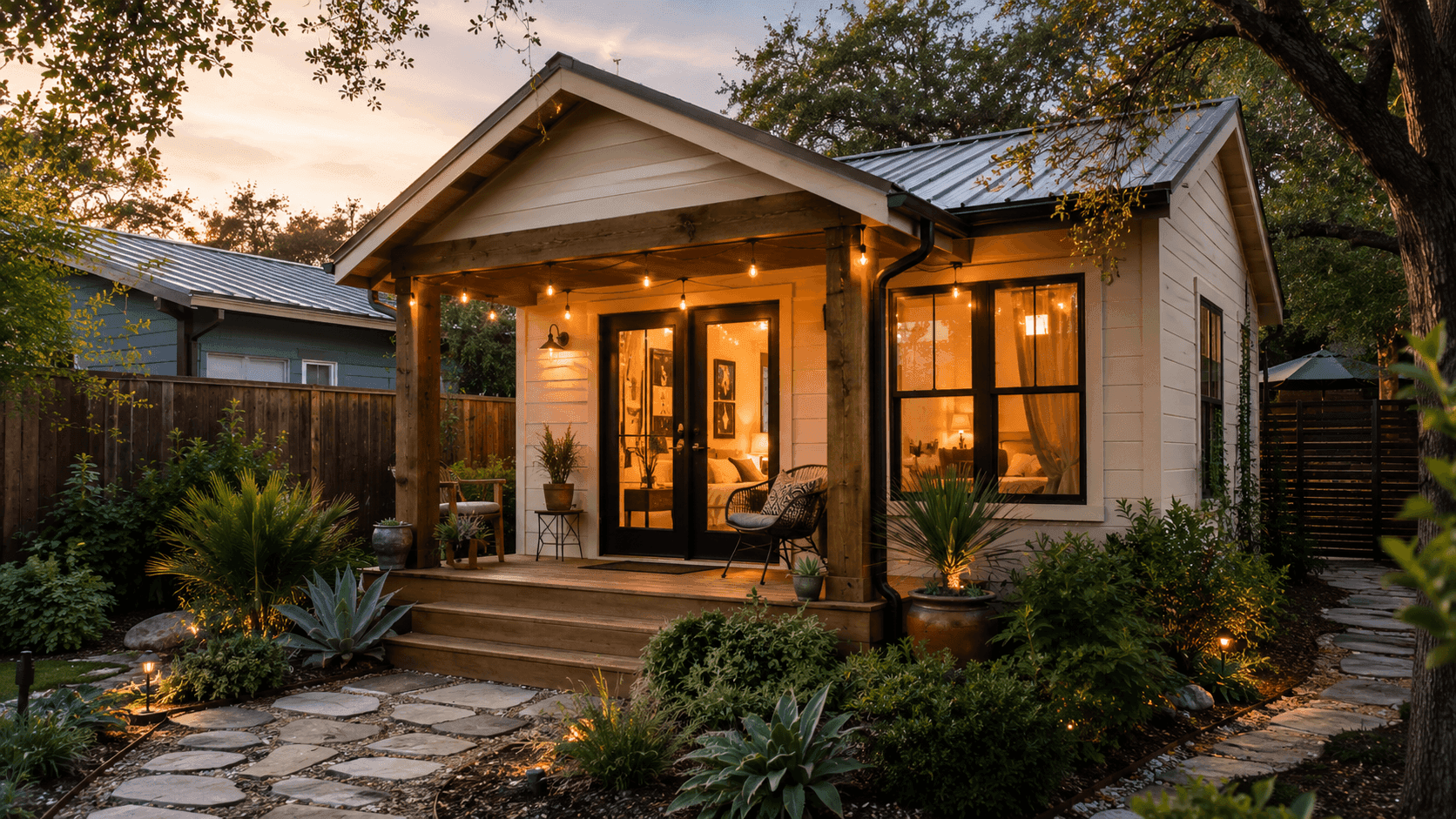
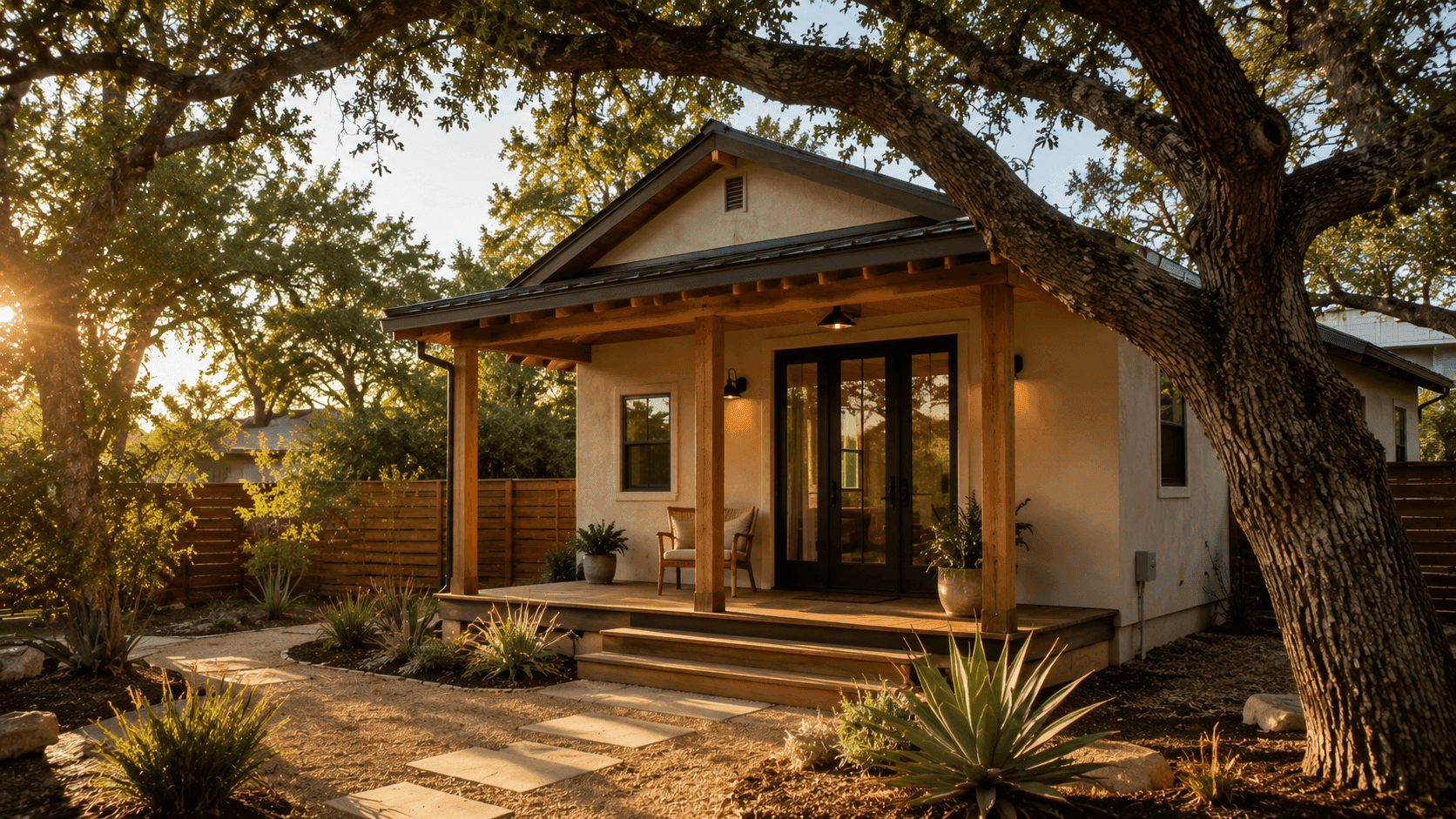
An accessory dwelling unit is a secondary housing unit on the same lot as a primary residence. In Austin, ADUs come in several forms: detached ADUs (also called DADUs or backyard cottages), garage conversions or garage apartments, attached ADUs connected to the main structure, and internal ADUs carved from existing living space.
Each type has different cost profiles, permitting requirements, and rental income potential. Detached ADUs offer the most independence and typically command the highest rents. Garage conversions are often the most cost-effective path for homeowners who already have the structure in place.
Austin's ADU Regulations in 2026
Under current Austin regulations, most single-family lots within the city limits are eligible for at least one ADU. The key parameters: ADUs can be up to 1,100 square feet or 15% of the lot area, whichever is smaller. Minimum lot size requirements have been significantly reduced from prior code. Setback requirements vary by neighborhood and lot configuration but have been relaxed from historical standards.
Critically, Austin no longer requires owner-occupancy to build or maintain an ADU. A property owner can rent both the main house and the ADU simultaneously — a rule change that opened the door to meaningful investment use cases that were previously unavailable.
Parking requirements for ADUs were also reduced. In many cases, especially in walkable urban neighborhoods, no additional parking is required.
How Much Does an ADU Cost to Build in Austin?
Construction costs for Austin ADUs in 2026 range widely by type and finish level. A basic garage conversion typically runs $80,000 to $150,000 depending on condition of the existing structure and desired finish level. A detached ADU built from scratch in Austin generally costs between $180,000 and $350,000, with variation driven by size, materials, site conditions, and contractor availability.
Permitting and design fees add $10,000 to $30,000 in typical projects. Foundation type, utility connection requirements, and whether the ADU will have a separate meter all affect total project cost.
The cost-per-square-foot for ADU construction is higher than standard residential construction due to the compact footprint and the per-project fixed costs that do not scale down proportionally. Buyers and investors should underwrite realistic numbers — not best-case estimates.
ADUs as an Investment Strategy
The investment case for ADUs in Austin is straightforward in high-rent neighborhoods: rental income from a well-positioned ADU in zip codes like 78704, 78745, or East Austin's 78702 can range from $1,500 to $2,500 per month depending on size, condition, and proximity to amenities.
At $2,000 per month, a detached ADU generating $24,000 in annual gross rental income on a $220,000 construction investment represents a gross yield of approximately 11% before maintenance, vacancy, and management costs. Net yields of 6–8% are achievable in well-chosen locations — competitive with other Austin real estate investment strategies.
ADUs also affect property value. A permitted, well-finished ADU adds meaningful resale value — particularly to buyers who intend to use rental income to offset their mortgage or to investors acquiring income-generating assets.
What Buyers Should Know About Properties with ADUs
For buyers, a property with an existing ADU is worth evaluating carefully on several dimensions. First: is the ADU permitted? Unpermitted ADUs present code compliance risk and cannot legally be marketed as rentable units. Always verify ADU permit status through the City of Austin Development Services Department before purchasing.
Second: does the ADU have a separate utility meter? Separately metered units are easier to manage as rentals and are more straightforward to account for in underwriting. Shared utilities require a clear arrangement with tenants.
Third: what is the realistic rental income for the specific ADU on the specific property? A 400-square-foot studio in Barton Hills is not the same rental opportunity as a 1,000-square-foot two-bedroom in Round Rock. Location drives ADU rental demand as much as it drives primary residence values.
What Sellers Should Know About ADUs
For sellers, an ADU is a meaningful asset — but how it is marketed determines how much value it captures. Listing an ADU property to the general buyer pool without highlighting the income component misses the most motivated buyers: investors and house-hackers who will pay a premium specifically for the income-generating capacity.
Sellers with permitted, well-maintained ADUs should document the rental history, provide clear permit records, and position the property explicitly to buyers who understand the investment value. That targeting — working with an advisor who knows how to reach investor-oriented buyers — is the difference between capturing the ADU premium and leaving it uncaptured.
The opportunity to add an ADU before selling is also worth evaluating for eligible properties in high-rent neighborhoods, though the timeline and cost-benefit analysis require careful underwriting relative to your specific property and market conditions.
Neighborhoods Where ADUs Create the Strongest Returns
ADU returns in Austin are highly location-dependent. The neighborhoods with the strongest ADU rental demand are those with high walkability, proximity to major employers or universities, and sustained rental demand from young professionals and graduate students.
Zip codes 78704 (Zilker, Bouldin, Barton Hills, Travis Heights), 78702 (East Austin), and 78745 (South Austin along South Lamar and South First) consistently show strong ADU rental demand. These areas attract renters who value walkability and neighborhood character — the same attributes that make the primary residences expensive to buy.
ADUs in suburban communities farther from the urban core are buildable but typically generate lower rents, which affects the investment math materially.
The ADU Opportunity Is Real — But Execution Matters
Austin's regulatory liberalization has created a genuine opportunity for homeowners and investors. But the opportunity requires careful execution: realistic cost underwriting, proper permitting, thoughtful design for the rental market, and clear-eyed underwriting of the income potential relative to the specific location.
Buyers, sellers, and investors who understand Austin's ADU landscape — and work with advisors who have navigated it — are positioned to capture value that the broader market has not yet fully priced.