No part of Austin has changed faster over the past fifteen years than the neighborhoods east of I-35. And no part of Austin is more frequently misunderstood by buyers arriving with impressions formed five years too late.
East Austin today is not the East Austin of the early 2010s, when buyers were drawn by affordability and cultural energy in equal measure. It is not the East Austin of 2018, when new bars and restaurants were appearing faster than buyers could track them. And it is not the East Austin of 2021 and 2022, when bidding wars pushed prices to peaks that required significant correction.
East Austin in 2026 is a maturing urban market — still dynamic, still culturally distinct, still one of the most interesting neighborhoods in the city to live in — but one that requires honest assessment of what you are buying, where exactly it is, and what the realistic outlook looks like from that specific address.
The Two Zip Codes and How They Differ
East Austin encompasses two primary residential zip codes: 78702 and 78721. They are adjacent, they share a cultural identity, and they are frequently treated as interchangeable. They are not.
78702 is the core. It includes East 6th Street, the Chestnut neighborhood, Cherrywood, Holly, French Place, and parts of the MLK corridor. These neighborhoods sit directly east of I-35, within walking distance or a short bike ride of downtown Austin. The cultural infrastructure that defines East Austin — the restaurants on East Cesar Chavez, the bars on East 6th, the coffee shops throughout Cherrywood, the food trailers on Manor Road — is concentrated here.
78721 stretches farther east — Govalle, Johnston Terrace, and areas approaching the airport corridor. It is meaningfully less expensive than 78702, has a somewhat different buyer profile, and does not have the same walkability to the 78702 cultural core. For buyers who are primarily motivated by price and see East Austin as a long-term appreciation play, 78721 provides an entry point. For buyers who want to live in the East Austin that they experienced on a Saturday afternoon, 78702 is the relevant zip code.
What You Can Buy and What It Costs
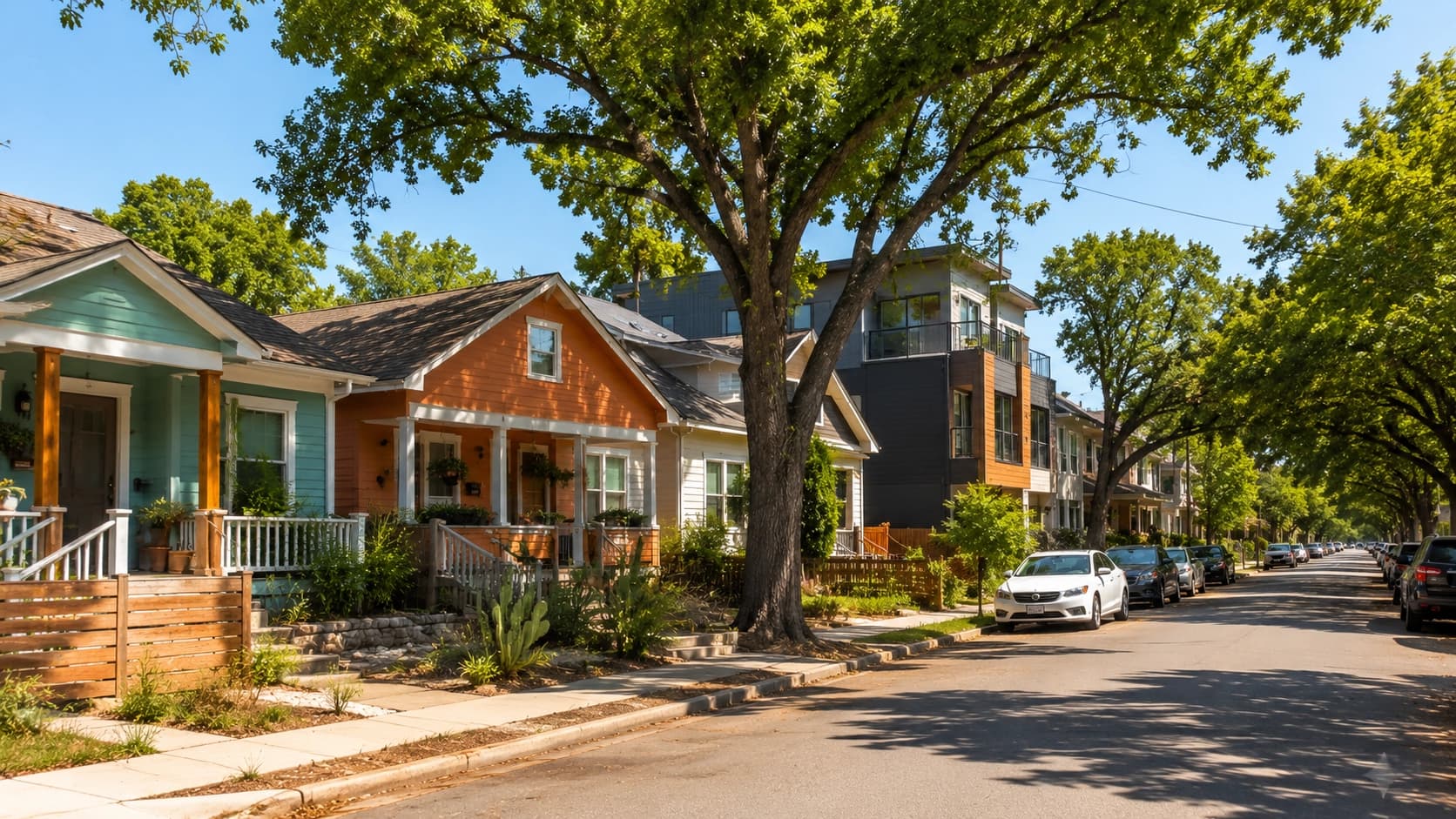
The East Austin housing stock is a study in contrasts. On the same block, you can find an original 1940s wood-frame bungalow, a new construction townhome, a converted duplex, and a recently completed single-family infill build — each with a different price, a different quality of construction, and a different set of trade-offs.
In 78702, single-family homes start around $500,000 for older structures in original condition on standard lots. Well-maintained or recently updated original bungalows range from $600,000 to $800,000. Newer construction single-family homes and larger updated properties with modern finishes range from $750,000 to $950,000. The top of the 78702 market — architecturally designed new builds on larger lots — can exceed $1,000,000.
Townhomes and condominiums in East Austin have grown as a product type as infill development has accelerated. Attached townhomes in 78702 typically range from $450,000 to $700,000 depending on size and finish level. These are common purchases for buyers who want East Austin proximity without the responsibility of a full single-family property.
78721 runs 15 to 25% less expensive than 78702 across comparable product types. Single-family homes in Johnston Terrace and Govalle start around $400,000 and reach $700,000 for well-maintained or updated properties.
The Lifestyle That East Austin Actually Offers
East Austin's residential appeal is rooted in cultural density in a way that most Austin neighborhoods are not. Franklin Barbecue, Veracruz All Natural, La Barbecue, Dai Due, Cenote, and dozens of other nationally recognized and locally beloved food destinations are in or adjacent to East Austin. The East 6th Street bar corridor is walkable from most of the neighborhood. The density of independent coffee shops, creative businesses, and cultural venues is unmatched elsewhere in Austin.
For buyers who choose a neighborhood based on how they want to spend their evenings and weekends, East Austin delivers an experience that no other Austin neighborhood replicates at a comparable price point.
The trade-off is residential character. East Austin neighborhoods are not quiet. East 6th Street generates noise that affects the immediately surrounding blocks late into the weekend nights. Construction activity has been continuous for over a decade and shows no signs of slowing. The neighborhood is still evolving — which means the block you buy on today may look meaningfully different in five years, and that difference could be positive or negative depending on what gets built.
School Zones in East Austin: Significant Variation
East Austin falls entirely within Austin ISD, and school quality within AISD varies more here than in most other Austin residential areas.
Elementary schools in East Austin include Metz Elementary, Campbell Elementary, Govalle Elementary, and others depending on the specific address. Performance ratings across these schools vary. Unlike Casis Elementary in Tarrytown or the Eanes ISD schools in Westlake, none of the East Austin elementary schools currently carry the same level of market-driving demand.
For buyers with school-age children who are motivated primarily by school quality, East Austin requires careful due diligence at the address level — not just neighborhood-level impressions. Verify the specific school assignment for any property using the AISD school finder, and research the school's current performance data independently.
This school zone dynamic is one of the primary reasons East Austin attracts a higher proportion of young professionals, investors, and buyers without school-age children relative to neighborhoods like Tarrytown or Westlake Hills.
East Austin as a Short-Term Rental Market
East Austin is one of Austin's strongest short-term rental markets — a natural consequence of its proximity to downtown, its cultural appeal, and its walkability to many of the venues that draw SXSW, ACL, and conference travelers. Properties in 78702 are among the most-searched Austin listings on short-term rental platforms.
Buyers considering East Austin for short-term rental use should verify STR license availability for the specific address before purchasing and understand Austin's STR licensing requirements, which distinguish between owner-occupied and investor-owned properties. The STR regulatory environment has evolved and may continue to change.
For buyers who intend to use a property both as a primary residence and as an occasional rental — particularly during Austin's peak event windows — the East Austin location provides income potential that can materially affect the ownership economics.
What Is Happening to East Austin: Development and Its Implications
East Austin has been one of the most actively developed residential areas in Austin for over a decade. The consequence is a neighborhood in continuous physical change — new construction filling vacant lots, older structures being replaced, multi-family development appearing on commercially zoned parcels near residential blocks.
This development has been the engine of East Austin's appreciation. It has also changed the neighborhood in ways that not all buyers anticipated at purchase. Buyers who paid a premium for a property adjacent to a vacant lot may now find that lot occupied by a three-story townhome development blocking a view or altering the block's character.
Before making an offer on any East Austin property, buyers should look up current zoning and any pending permits for adjacent and nearby parcels. The City of Austin's development portal provides this information publicly. An advisor familiar with East Austin's development patterns can help interpret what current activity means for a specific address.
Who Buys in East Austin
East Austin attracts a distinctly different buyer profile than Tarrytown or Westlake Hills. The most common buyer is a professional in their late 20s to early 40s — often single or in a couple without school-age children — who values walkability, cultural access, and urban living over lot size and school zone.
Investors purchasing for short-term rental income or long-term appreciation are more concentrated in East Austin than in most other central Austin neighborhoods. This investor presence affects both the buyer competition and the neighborhood character on some blocks.
Relocation buyers who have done their research and specifically identified East Austin's lifestyle appeal are a meaningful segment — often buyers from Brooklyn, Silver Lake, or other urban neighborhoods who are recognizing that East Austin offers a similar lifestyle at a materially lower cost.
The Long-Term Outlook
East Austin's appreciation over the past fifteen years has been substantial and well-documented. The question for buyers in 2026 is what the next decade looks like from here.
The fundamentals that drove East Austin's appreciation — walkability, cultural density, proximity to downtown, and sustained lifestyle demand — remain in place. The neighborhood is no longer undervalued relative to the rest of Austin in the way it was in 2010 or even 2015, which means the pace of future appreciation is more likely to track the broader Austin market than to outperform it significantly.
East Austin is a strong long-term hold for buyers whose lifestyle aligns with what the neighborhood offers and who understand the trade-offs clearly. It is a less obvious choice for buyers seeking the maximum long-term appreciation or school-district security of Tarrytown or Westlake Hills.